
Selling the Invisible: A Data-Driven Approach for Enabling In-Memory Computing for Edge AI
When bringing novel hardware to market, customers need solutions, not IPs and generic metrics, with workload-specific evidence turning abstract claims into concrete sizing and integration decisions.
The Adoption Gap
Edge devices are expected to run complex AI and signal-processing under strict constraints on chip size, energy, latency, and privacy. In microcontroller-based systems, the limitation is not compute availability but the cost of moving data between memory and compute. In-memory computing (IMC) reduces this overhead by executing operations on stored data, but adoption remains challenging. Customers are reticent to base adoption decisions solely on technical or academic collateral. They need pre-silicon, workload and System-on-Chip (SoC) context-specific evidence. Without that, ROI remains uncertain, evaluation cycles extend, and decisions stall.

Novel architectures like Synthara’s ComputeRAM break both hardware and software barriers by providing a digital, ISA-agnostic SRAM IP with built‑in matrix-algebra capabilities exposed via a standard SRAM interface, together with software integration solutions. While this architectural flexibility is a key part of the value proposition, it creates a new business challenge by expanding the design space, as end benefits depend not only on workload partitioning and scheduling but also on the underlying architecture.
Solving the “Flexibility Paradox”
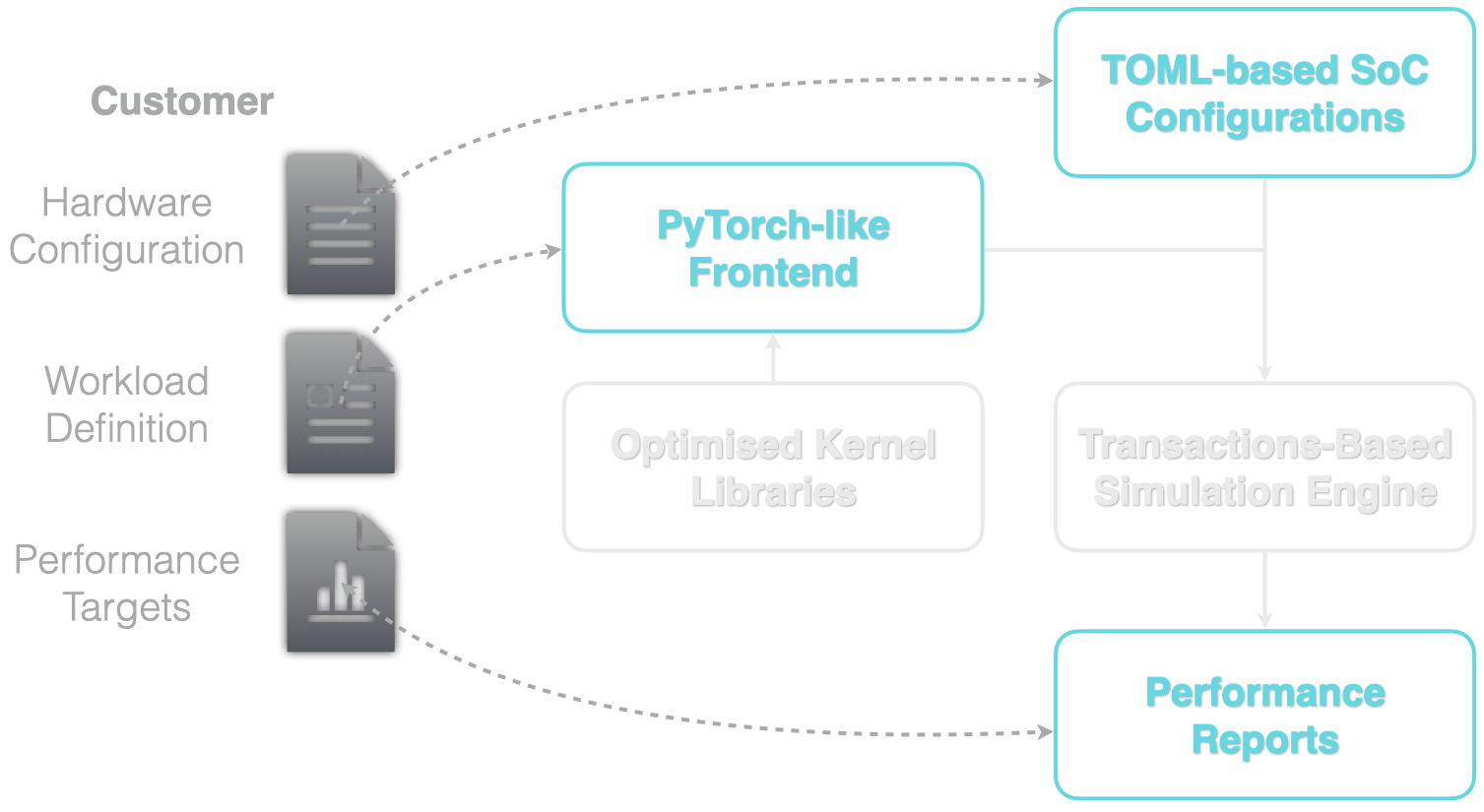
To address the validation gap, the team shifted from “selling specifications” to delivering repeatable, workload-specific, data-driven evidence. The team developed a transaction-level simulator that models configurable ComputeRAM-enabled SoCs, configured using TOML files, and calibrated against silicon measurements and reference baselines. Customer workloads interact with the simulator via a PyTorch-like API that calls a library of pre-implemented kernels optimised for ComputeRAM. This workflow enables the production of rapid and comparable workload-specific performance reports, including latency, energy, power, area, and interconnect traffic, moving engagements from uncertain conversations based on abstract specs to concrete integration plans.
Data-Driven Transformations
By operationalising this simulation-driven workflow, the pre-sales engagement model was transformed, leading to:
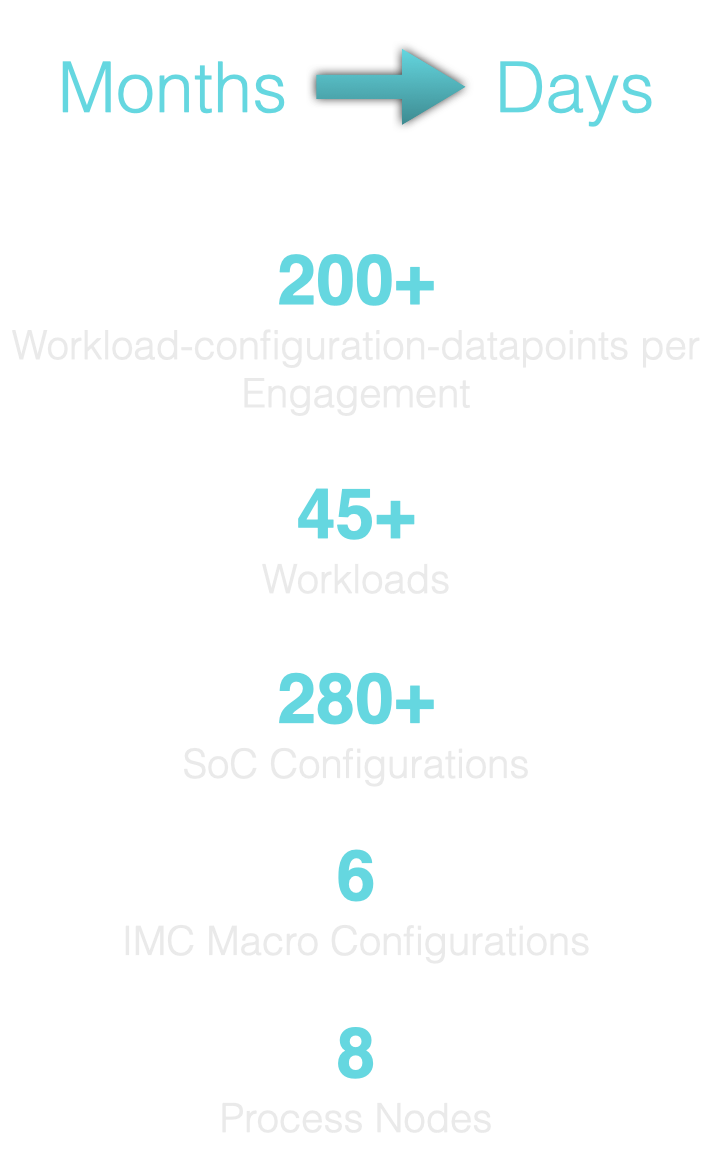
- Accelerated engagements and shortened decision cycles, reducing pre-sales exploration from multi-month cycles to days, lowering customer-specific benchmarking efforts.
- Improved technical alignment on integration paths by proving the performance benefits and flexibility of ComputeRAM to accommodate different workloads and be ported to various hardware configurations and process nodes.
- Optimisation at scale, with over 200 workload-configuration-optimisation combinations benchmarked per customer engagement, enabling convergence on setup recommendations.
- Increased workload and platform robustness, with a growing library of over 45 distinct workloads (from DFT kernels to YOLOv5), 280 unique SoC setups, 6 IMC configurations and 8 process nodes, providing a rich dataset for identifying performance patterns and guiding future optimisations.
Lessons Learned
Beyond headline metrics, this approach also surfaced several non-obvious methodological constraints:
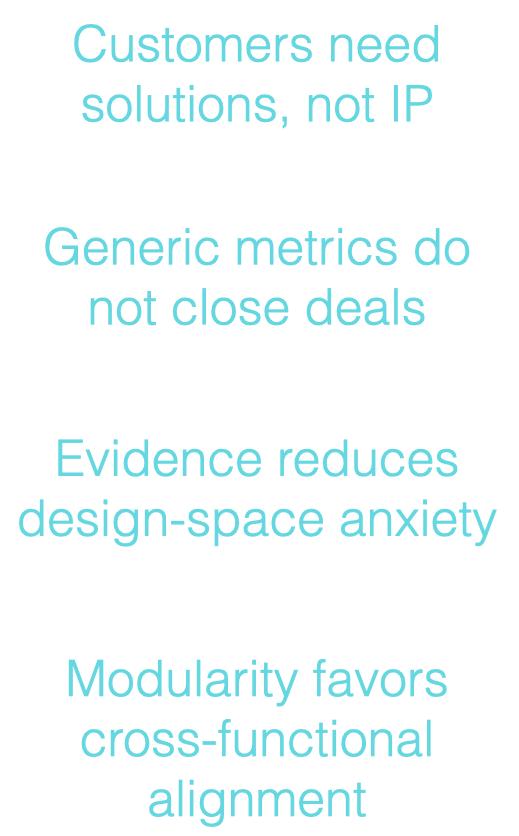
- Customers need solutions, not IP. Understanding and framing customers’ problems revealed that kernels, scheduling, and integration tooling are part of the product, driving insights back to software and hardware teams.
- Relying on generic metrics and benchmark claims (e.g., TOp/s/W) is detrimental, obscuring core value, with customers requiring concrete performance metrics, like joules and clock cycles, for their specific workloads and setups.
- Workload-specific evidence reduces decision anxiety by constraining the design space, and accelerates alignment, decisions and consensus by de-risking innovation adoption.
- Modularity favours collaboration, allowing cross-functional teams to work together to close deals, leading to faster customer turnaround and fewer iterations.
Disclaimer
Synthara has permitted me to share the above information for fair personal use. Further details remain confidential. Case study based on customer-facing work in edge-AI and DSP on embedded hardware. Presented at SDS2026 in a personal capacity. No customer-identifiable or confidential data included.